
Chief Financial Officer's Report
The University of Michigan stands at a pivotal moment, continuing to advance its mission to the public as a leader in education, research and patient care. In a year of new challenges and opportunities, our university community remains committed to a bold course for the future.
Under the leadership of President Domenico Grasso and our Board of Regents, the Look to Michigan vision is inspiring transformative initiatives across our campuses. Alongside this, Campus Plan 2050 provides a strategic roadmap for the physical evolution of our university, ensuring our infrastructure supports the priorities identified in the vision. As higher education evolves and global challenges persist, these frameworks guide innovation, collaboration and impact — anchored by our shared commitment to the public good.
Throughout 2025, U-M has sustained its strong financial foundation, world-class academic reputation and operational agility. These strengths have allowed us to maintain stability, invest strategically and support our mission of educating students, driving groundbreaking research and delivering outstanding health care to our communities.
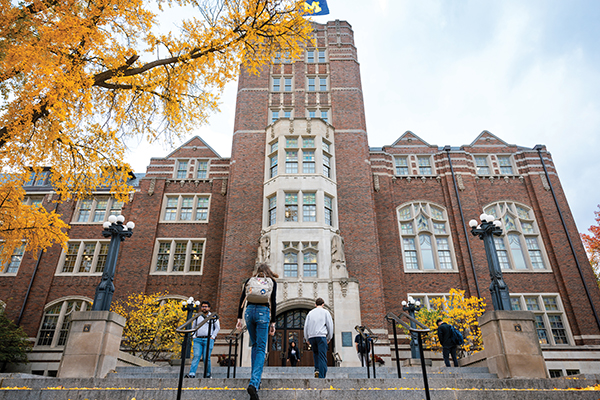
This year’s achievements — including advances in research, record student enrollment and continued clinical enterprise expansion — reflect the dedication of our university community and extend U-M’s impact across Michigan and beyond. In an evolving higher education landscape and amid shifts in the broader economy, the university continues to demonstrate resilience and forward-thinking. Our financial management is proactive, steady and focused on long-term sustainability — ensuring that U-M is well positioned to meet new challenges and seize emerging opportunities.
Looking ahead, we remain committed to stewarding our resources wisely. With sound financial management and a vibrant university community, U-M is poised to shape a brighter future for our campus and the broader world.
MAINTAINING A STRONG FINANCIAL POSITION
The university’s financial position continues to be strong, with total assets and deferred outflows of $38.0 billion and total liabilities and deferred inflows of $13.1 billion at June 30, 2025. Net position — which represents the residual interest in the university’s total assets and deferred outflows after total liabilities and deferred inflows are deducted — increased $2.7 billion to $24.9 billion at June 30, 2025, primarily due to strong investment returns.
Although net investment income can be volatile from year to year, U-M’s endowment distribution policy and long-term investment approach work together to provide reliable annual support for operations. We smooth the impact of capital market volatility by providing for annual distributions of 4.5 percent of the seven-year moving average fair value of the University Endowment Fund.
Thanks to this strategy and continued growth of the endowment, U-M provided a record $538 million of distributions to support university operations in FY 2025. Distributions from more than 13,300 individual endowments consistently fund a wide range of needs across campus — including student scholarships, endowed professorships, clinical services and research initiatives.
Endowment funds, primarily invested through the university’s Long Term Portfolio, increased $2.0 billion to $21.2 billion at June 30, 2025. The table below highlights the performance of U-M’s Long Term Portfolio compared to benchmark portfolio returns.
INVESTMENT PERFORMANCE
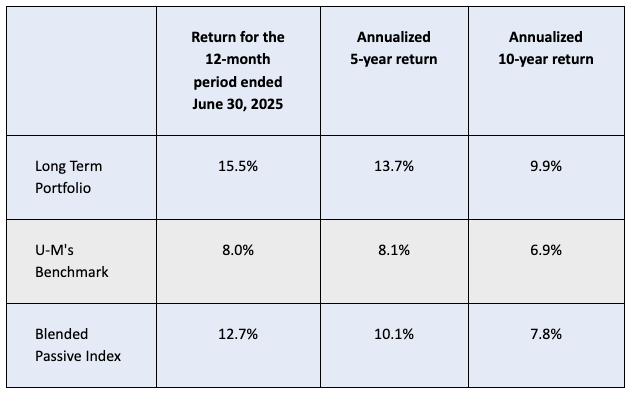
Reflecting its diverse strategy, the Long Term Portfolio’s FY 2025 performance was led by strong positive returns in equities, absolute return, private equity and real assets. U-M continued to benefit from an emphasis on climate solutions-related investments, which were among its highest-performing investments. The university’s private investments also fared well relative to their benchmarks, particularly with respect to private equity and infrastructure. U-M’s Long Term Portfolio generated a 15.5 percent return for the year against this backdrop, which compared well to other large endowments.
The university’s commitment to portfolio diversification has also proven valuable over longer time periods. With a five-year annualized return of 13.7 percent and a 10-year annualized return of 9.9 percent, the Long Term Portfolio is in the top decile of performance relative to other college and university endowment investment portfolios. Similarly, the Long Term Portfolio’s 20-year annualized 9.2 percent return places it well within the top 10 percentile of performance, and compares favorably to the 7.3 percent annualized return for the median university endowment over the same period.
DIVERSIFICATION IN REVENUE STREAMS
U-M has a diversified revenue base, which has enabled the university to remain financially stable through various economic cycles and challenges as well as avoid unnecessary dependence on student tuition and fee increases. The components of the university’s sources of revenue are depicted below.
The state of Michigan continues to provide essential financial support to U-M. In FY 2025, state educational appropriations totaled $425 million. We greatly appreciate the state’s ongoing commitment and support for higher education and the University of Michigan.
U-M’s operating budget continues to balance academic excellence and investment in the future with student affordability and access. For the Ann Arbor campus, tuition rate increases for FY 2025 were 2.9 percent for in-state undergraduate students and 4.9 percent for non-resident undergraduate students and most graduate students. For the Dearborn campus, tuition rate increases were 4.7 percent for in-state undergraduate students and 4.9 percent for graduate students. For the Flint campus, tuition rate increases were 4.9 percent for in-state undergraduate students and 4.0 percent for graduate students.
The FY 2025 budget also included a 6.3 percent increase in financial aid for undergraduates on the Ann Arbor campus, with 9.0 percent and 8.3 percent increases in institutionally awarded aid on the Dearborn and Flint campuses, respectively. U-M has been able to limit tuition increases and provide generous financial aid in large part through its long-standing focus on cost containment strategies and operational efficiencies.
Demand for a U-M education continues to climb. The more than 100,000 prospective first-year-student applications submitted for the university’s three campuses set a record. This is the 18th consecutive year that applications have increased. U-M’s impressive global reputation and incredible value make it a top destination for outstanding students from Michigan, throughout the United States and across the world.
DIRIVING DISCOVERY AND SOCIETAL IMPACT
Across U-M’s three campuses, teams worked together throughout the year to advance knowledge and discovery for the public good, reinforcing the university’s commitment to serve society through research, scholarship and creative practice.
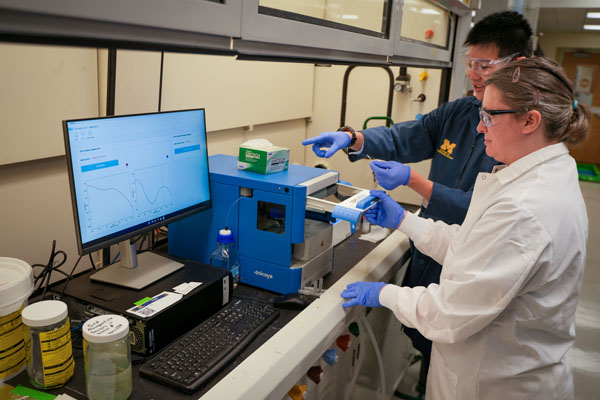
The university achieved a record $2.16 billion in research expenditures in FY 2025, reflecting Michigan’s leadership in improving health, advancing technology and addressing society’s most pressing challenges. The Office of the Vice President for Research launched several new initiatives to strengthen interdisciplinary collaboration and enhance competitiveness for corporate, philanthropic and government funding. Among them were Impact Institutes, which provide seed funding to launch and grow interdisciplinary research centers, and Building Better Futures, a grant program supporting innovative scholarship addressing complex societal challenges. These efforts complement existing programs such as Innovation Partnerships and Bold Challenges, further expanding the reach of the university’s research ecosystem.
As a leading public research university, U-M continues to translate new knowledge and discoveries into real-world impact. In FY 2025, Innovation Partnerships facilitated the launch of 31 new startup companies and recorded a record-breaking 673 invention reports, supporting job creation and driving technologies that address societal needs.
Building on the priorities outlined in our Look to Michigan vision, the university expanded its focus to include advanced technology as a core pillar, highlighting a commitment to responsible innovation alongside education, health, civic engagement and sustainability. To further strengthen collaboration and national leadership in emerging fields, the Office of the Vice President for Research launched the AI Institutes at Michigan and established the Office of National Laboratories to deepen partnerships with the U.S. Department of Energy’s national laboratories.
GROWING COMPREHENSIVE ACADEMIC MEDICAL CENTER
Michigan Medicine continues to earn national recognition for leadership in advanced patient care, cutting-edge research to improve human health and comprehensive education of physicians and medical scientists. It includes University of Michigan Health (UMH), University of Michigan Medical School and Michigan Health Corporation.
UMH represents the combined clinical operations of facilities across southeastern Michigan along with the university’s statewide network of hospitals, hospital joint ventures and other hospital affiliations, primarily consisting of UM Health-Sparrow and UM Health-West. UMH, which currently includes 11 hospitals and hundreds of clinics, achieved positive financial results in FY 2025 with an operating margin of 1.3 percent — or $109 million — on operating revenues of $8.7 billion.
Michigan Medicine continues to expand its expertise through investment in infrastructure, new clinics and a statewide network of integrated, cost-effective and high-quality health care services for the patients and communities it serves across Michigan. This includes the D. Dan and Betty Kahn Health Care Pavilion, a new world-class hospital with advanced clinical capabilities, including a state-of-the art neurological and neurosurgical center, high-level specialty care services for cardiovascular and thoracic patients and advanced imaging services. This facility, which will open in November 2025, was also designed to achieve LEED Platinum certification for environmental sustainability.
By improving access and experience, promoting and supporting continued innovation and advancing clinical integration with an emphasis on providing care when and where it’s needed most, Michigan Medicine is growing its strong foundation of clinical excellence to serve the people of Michigan and beyond.
A BRIGHT FUTURE FOR MICHIGAN
Because of its financial strength, the University of Michigan remains well positioned to move forward with our Look to Michigan vision and Campus Plan 2050. U-M is one of only seven public universities in the country to earn the highest possible credit ratings from S&P Global (AAA) and Moody’s (Aaa). We’ve maintained these outstanding ratings for years, which is a clear indication of our long-term financial strength and stability.
To maintain excellence in education, research and patient care as well as offer collaboration opportunities for multiple disciplines, U-M makes important capital investments in a wide array of its facilities. An overview of the capital projects completed, in progress and in planning during FY 2025 appears in the Major Projects section. U-M has long balanced investing in new facilities against renewing existing facilities, which enables us to avoid an excessive accumulation of deferred facility maintenance.
Through prudent financial management and focus on environmental stewardship, U-M is well positioned to advance its mission and build a resilient, sustainable future.
Please review Management’s Discussion and Analysis in conjunction with the audited financial statements. This section of the annual report includes additional details about U-M’s financial strength, prudent financial policies and commitment to excellence. When combined with our extraordinary employees dedicated to the public good, U-M is well situated to continue making contributions that enrich the world.
Sincerely,

Robert A. Hewlett III
Interim Executive Vice President and Chief Financial Officer